
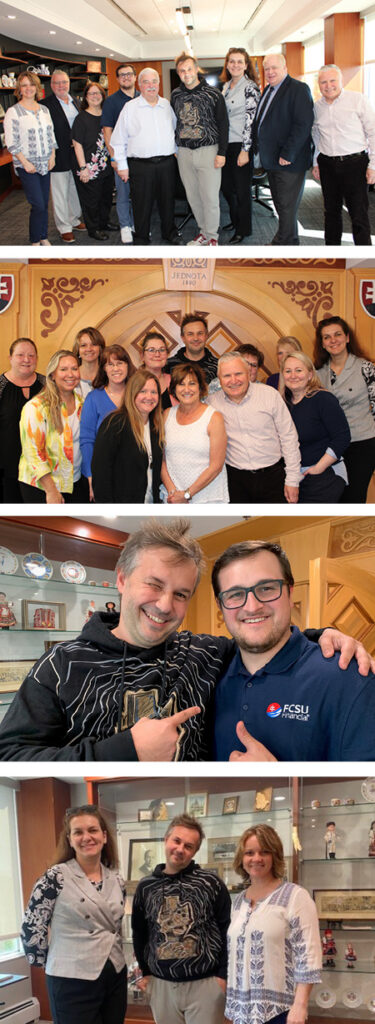
 FCSU guests and staff had the distinct pleasure of welcoming acclaimed Slovak film director Miro Remo to the Home Office during his visit to Northeast Ohio for the Cleveland International Film Festival.
Remo, whose documentary Better Go Mad in the Wild has garnered international attention, spent several hours in a lively and engaging bilingual discussion with FCSU representatives and guests. Among those present were President Ken Arendt, Executive Secretary Kevin Collins, Chief Marketing Officer Beata Fedoriouk, Supreme Court member John Moynihan, President of the Slovak Radio Club Henry Horvath, Branch 24 Members Sue Moynihan and Joe Oros, and Renáta Kamenárová, and PhD, Director of the Slovak Studies Program at the University of Pittsburgh, who assisted as translator.
The conversation offered a fascinating behind-the-scenes look at Remo’s filmmaking process. The inspiration for Better Go Mad in the Wild came from an unexpected source—his father, an amateur filmmaker, who shared a short book about twin brothers living reclusive lives. Intrigued, Remo pursued the story, eventually committing five years to the project. Filming was limited to just 60 days per year, respecting the brothers’ desire for privacy and their need to focus on daily work.
The documentary captures the complex relationship between the twins, one of whom lived with a disability, having only one arm. Initially hesitant, the brothers ultimately agreed to participate. In a poignant turn of events, one of the brothers passed away just days after viewing the completed film.
Although the story is deeply personal and rooted in rural life, the film was shot in the Czech Republic, where the brothers lived. Remo explained that securing financing was more feasible there than in Slovakia, highlighting challenges filmmakers often face in smaller national industries.
Following his Cleveland appearance, Remo continued promoting the film with stops planned in Chicago and Frankfurt, bringing Slovak storytelling to broader international audiences.
Remo also shared insights into his upcoming project, which will explore the lives of garbage collectors in Slovakia. The film will examine the social hierarchy within this often-overlooked profession, where truck drivers hold the most coveted positions and informal practices sometimes shape the work. The project is currently in its early stages.
Beyond filmmaking, the discussion turned to Slovak culture and identity. It was noted the contrast between Slovak communities abroad and those in the homeland. While Slovak-Americans have worked diligently to preserve traditions, Slovakia itself has experienced increasing Western influence. Attendees reflected on earlier generations of immigrants who, amid political tensions and pressures to assimilate, often felt compelled to suppress their language and cultural practices.
The visit concluded with gratitude and mutual appreciation. FCSU members expressed their thanks for the opportunity to connect with such a thoughtful and accomplished artist, while Remo welcomed the chance to engage with a community dedicated to preserving Slovak heritage.
Kevin Collins and Beata Fedoriouk later attended Remo’s festival screening, continuing to support Slovak arts and culture on an international stage.