
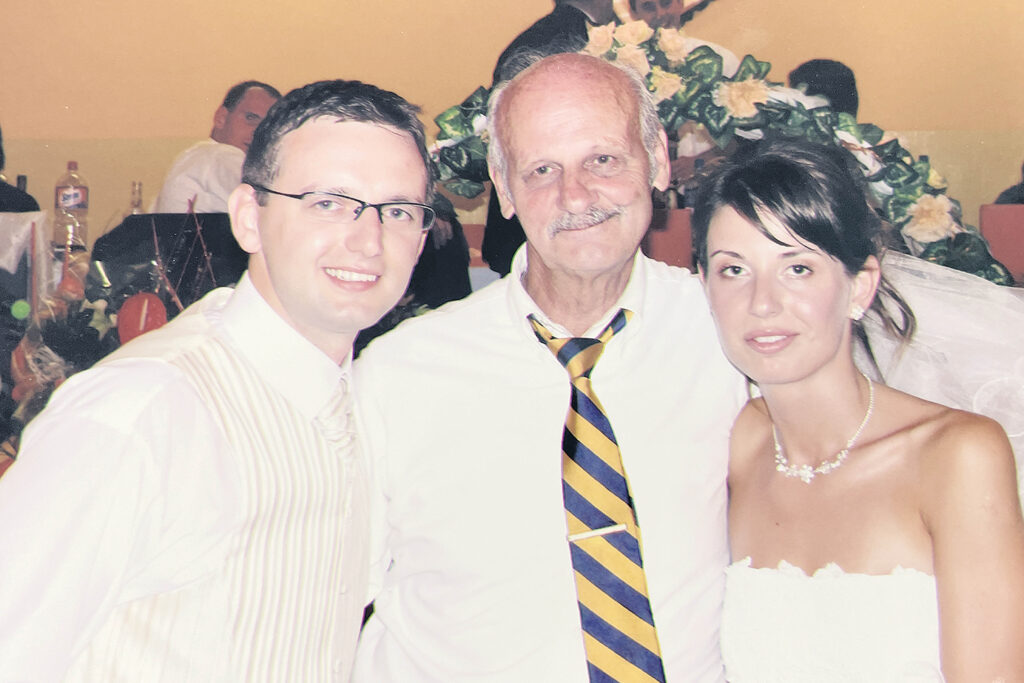
 Vince Stankay, 88, is a lifelong member of the FCSU and proud of his Slovak Catholic heritage. His parents were members of Branch 35, and Vince and his entire family belong to Branch 888. Three of his grandparents were from Slovakia, and one grandmother was from Poland. His father, Joseph Stankay, was born near Bretejovce (Ploské) in Eastern Slovakia in 1893. His mother, Zuzanna (Ulias) Stankay, was born near Ladomirová (Krána Poľana) in 1898. Joseph emigrated to the United States in 1909; Zuzanna arrived in 1912.
They both settled and met in Braddock, Pennsylvania, home of the U.S. Steel Edgar Thomson Works, where Joseph worked for his entire career. The couple married in 1916 and had nine children over 21 years. Two of Vince’s brothers, Joseph and Steven, died before his birth in 1937. He was raised with siblings Elmer (1921), Albert (1923), Andrew (1924), Florence (1927), Martha (1928), and Joseph (1932).
Growing up during the Great Depression, Vince remembers his older brothers pulling a steel wagon around town to gather wood for heating. His father worked occasionally for the priest at St. Michael’s Catholic Church and took on odd labor jobs. His mother did house cleaning and sewing. Like many families of the time, they bought groceries “on the books” at the local store. After the Depression, Zuzanna repaid their entire debt. The store owner told her, “Mrs. Stankay, you are one of the few who paid me back in full.”
Vince began working at a local supermarket at the age of 16. When his father passed away in 1957, Vince was just 19 and spent the next 18 months helping to support his mother. He met his future wife, Maryanne Matta, at St. Michael’s, a Slovak Catholic church, where they later married in 1963—the same church where his parents had been wed. Together, they raised four children and shared 45 wonderful years of marriage.
In the 1980s, with the collapse of the steel industry, the economy in Braddock suffered. Vince, then a grocery store manager, worked three part-time jobs but still struggled to make ends meet. When his brother-in-law was offered a job in West Palm Beach, Florida, Vince helped him move—and saw new opportunities. Maryanne, a registered nurse, could easily find work. With God’s guidance, they discussed the move with their children—Diane, Christine, Michael, and Paula—and made the life-changing decision to relocate. It was a blessing. Vince found work in telecommunications and later retired from a law firm. After Maryanne passed, Vince found love again. At the age of 73, he remarried Josephine and they have enjoyed 15 years together so far.
Returning to His Slovak Roots
A proud Slovak, Vince always wanted to learn more about his ancestry. He reached out to Helene Cincebeaux, a fellow FCSU member known for leading genealogy tours in Slovakia. With her help, he connected with relatives on both sides of his family.
In 2000, he traveled to Slovakia and immersed himself in the language, culture, and people. He spoke Slovak fluently, and meeting locals felt like reuniting with long-lost family. As he recalls, “Once you meet them, it’s as if you’ve known them forever—because they’re your family. It’s in the blood. Slovak people are friendly, happy, and love to sing and dance. My wish is that they don’t lose their heritage to modern ways. I know progress is necessary, but I pray future generations hold onto their traditions.” In August 2008, Vince made a second trip to Slovakia, spending one week with his father’s side and one with his mother’s. The visit ended with the wedding of his cousin Peter Micenko in Vyšná Jedľová, a village of just 360 people.
A Traditional Slovak Wedding
Vince shares his experience. “The musicians came to the house and the celebration began. We entered the room where the starosta (best man) stood, holding the valashka (ceremonial axe). He knocked on the door three times, and the musicians played. The priest prayed as the bride and groom asked their parents’ permission to marry. Peter’s grandfather, 92 years old, gave his blessing. With music leading us, we walked through the village to the church. The bride and groom wore live greenery crowns and held beeswax candles. They walked three times around the altar before signing the marriage book. Afterward, they greeted everyone in a receiving line. Guests brought long-stemmed flowers that were collected and used as decoration at the reception. The reception at the Kultúrny Dom (Culture Hall) was unforgettable. Upon entering, the couple was welcomed with a champagne toast, and the head cook ceremonially broke a plate. According to tradition, how well the newlyweds work together to sweep up the shards symbolizes their future teamwork in marriage—and the number of larger pieces left on the floor is said to predict how many children they will have.
A man danced with a decorated tree, and everyone—young and old—knew the lyrics to all the songs. The reception lasted from 2pm Saturday until 5am Sunday. We had three full meals! The starosta danced around a vodka bottle, then others danced between two, even stacking one on top of another without knocking them over. They placed the bride’s veil on the valashka, and the starosta danced with it. The bride stepped on her groom’s flower and later changed into her Slovak kroj (folk costume). We all danced the Redový (bridal dance), and at the end, the groom came to take her away.”
A Life of Faith and Gratitude
Vince closes his story with heartfelt words. “This is a memory I will treasure forever. God bless my parents for all they sacrificed for me and my siblings. They always said, ‘Don’t forget God in your life’, and ‘By working together in marriage, you can do anything.’ My mother also said, ‘If you always give, you always have.’ Truer words were never spoken.
Za Boha a Za Národ – For God and For Country. Zbohom – Go with God.”